India mobile game distribution in 2026: the channel stack beyond Google Play
Play fees, OEM stores, UPI web checkout, Indus Appstore, Nazara co-publishing and the 2025 Online Gaming Act: a decision tree for publishers entering India.
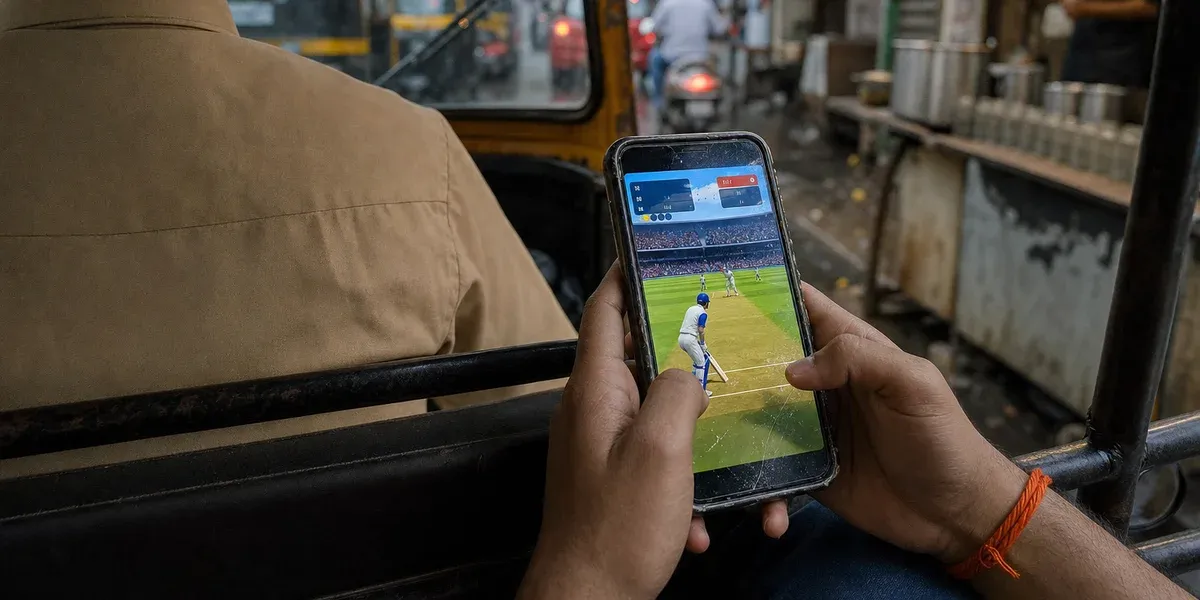
Direct answer — how should a game publisher distribute in India beyond Google Play in 2026? Treat Google Play as the base layer, not the plan: India is not among the regions Google names for earlier repricing, so Play still runs on its 15%/30% fee card there until the Rest of World rollout on 30 September 2027, and it offers an easily overlooked 4-percentage-point discount for alternative billing. On top of it, add the OEM stores of the four Android brands leading India’s smartphone shipments, a UPI-first web checkout, possibly the Indus Appstore and, if you lack local publishing muscle, a co-publisher such as Nazara Publishing. Then check your game economy against India’s 2025 Online Gaming Act, which bans real-money games outright.
In India, “we launched on Play” says little about reach. UPI is a first-class rail on both default stores, and since 2025 a gaming statute decides what kind of game you may run. This playbook covers the channel stack; payment conversion mechanics live in our guide to direct carrier billing. As in our other regional playbooks, we don’t quote an Indian games market size: the 2026 figures circulating come from report mills without a published method, and none of the decisions below depend on them.
What does Google Play actually cost and offer in India?
India is not among the regions Google names for earlier dates in its 2026 repricing (EEA, UK, US, Australia, Japan, South Korea), so it falls in the “Rest of World” rollout on 30 September 2027. Until then, Play’s standard rate card applies to Indian transactions: for developers enrolled in the 15% tier, 15% on the first $1M (USD) a developer earns each year, 30% above that, and 15% on auto-renewing subscriptions.
The India-specific lever is alternative billing. Google runs a separate user choice billing programme for India open to “gaming & non-gaming mobile or tablet apps with users in India”. On transactions where the player pays through the developer’s own billing system, the service fee is reduced by 4 percentage points: a 15% fee becomes 11%. A studio already running its own payment stack for web sales gets that discount almost free.
That programme traces back to regulation. In October 2022 the Competition Commission of India found Google had abused its dominant position through its Play Store billing policies and directed that Google “shall allow, and not restrict app developers from using any third-party billing/ payment processing services”. On appeal in March 2025, the National Company Law Appellate Tribunal upheld that direction and cut the penalty from Rs 936.44 crore to Rs 216.69 crore, according to PTI.
On the player side, check what the default checkouts accept. Google’s India payment page lists cards, UPI (“Google Play supports UPI for all providers”, including UPI Autopay for subscriptions) and Play balance. It also notes that netbanking was discontinued from October 2025. Apple’s payment methods page lists UPI, cards, Apple Account balance and Net Banking (adding funds only) for India. Neither page lists carrier billing for India.
Deciding which of these layers to run yourself and which to run through a partner holding the OEM and payment relationships is what our distribution practice helps studios work through.
Which OEM channels matter in India right now?
The ranking moves fast. Omdia’s Q3 2026 data puts India’s smartphone shipments at 35.8 million units, down 26% year on year and the lowest third-quarter volume since 2016. Samsung led the quarter at 6.7 million units, followed by vivo at 6.4 million, OPPO at 4.9 million, Xiaomi at 4.7 million and Apple at 3.9 million. Omdia’s analyst puts the combined share of Chinese OEMs in India’s shipments at roughly 68% in Q3 2026, down from 75% in Q3 2025.
Two corrections to common pitch-deck claims follow. First, Xiaomi is not India’s leading smartphone brand today: it was fourth by Q3 2026 shipments, with volume down 28% year on year. Second, these are smartphone shipment figures for one quarter. They tell you which OEM stores and preload slots reach new devices, not who owns India’s gaming audience or its installed base.
The practical reading:
- Samsung, vivo, OPPO and Xiaomi together accounted for 22.7 million of the 35.8 million Q3 2026 shipments. Their app stores and preload programmes are the OEM layer worth negotiating in India; the deal mechanics are in how to land an OEM preload deal.
- A falling market changes preload maths. Fewer new devices means fewer fresh preload impressions: tie placement to a defined device range, not a promised volume.
- Plan for developer verification. Google’s Android developer verification began protecting users on 30 September 2026 for installs from participating stores in Brazil, Indonesia, Singapore and Thailand. Google says verification “will be expanded globally for all apps on certified Android devices in 2027”. Register every OEM-store and off-store build you open in India now.
Which payment rails, stores and partners belong in the stack?
In India the payment rail decides who can pay you outside the default stores, so it is a distribution decision.
A UPI-first web checkout. Outside Play and the App Store, you need UPI. Xsolla relaunched UPI and Net Banking in India through Xsolla Pay Station in August 2025. Pair it with Play’s India user choice billing and the same checkout earns the 4-point discount in-app. Our web shop and DTC playbook covers the store side.
Carrier billing for the prepaid tail. UPI needs a linked bank account, and Play’s and Apple’s India pages list no carrier billing. Direct carrier billing is therefore a rail you bring through your own checkout, an aggregator or an OEM store, not one the default stores provide. Our 2026 reach map sets out where it adds payers that UPI misses.
The Indus Appstore. PhonePe’s Android store, launched in February 2024, was built around India-specific terms. It lets developers “choose any 3rd-party payment gateway for in-app billing”, and PhonePe said they “will not be charged any commission if they use an external payment gateway”. At launch it offered discovery in 12 Indian languages and waived listing fees for a year. Those are launch-day terms: confirm the current fee schedule before you model it. Indus suits a title already running its own UPI checkout; it does not replace the OEM layer.
A local co-publisher. Worth it when you need Indian user acquisition, localisation and live-ops capacity faster than you can hire it. The most visible route is Nazara Publishing, the publishing division of listed Nazara Technologies, launched in October 2023 “to launch high-quality games for the Indian and International markets”. Nazara said it would localise games from Indian and global developers for India and support them on “game design, localisation, data analytics capabilities, beta testing and quality assurance, enhanced monetization and strong distribution through smart user acquisition spends and platform partnerships”. Its December 2023 update said it aimed to publish 20 games within 12 to 18 months, investing between INR 1 crore and INR 3 crores per game. Nazara has not published a standard revenue-share term, so treat any split as negotiated. A co-publisher brings reach and capital and takes margin and roadmap control: choose it for a title whose fit with Indian players you can’t yet prove alone, not for one already converting on Play.
What does India’s Online Gaming Act change for distribution?
It sets the boundary of what you can ship. The Promotion and Regulation of Online Gaming Act, 2025 “comprehensively prohibits all forms of online money games, whether involving games of chance, games of skill, or any combination thereof”. It also prohibits their advertising and “the processing of related financial transactions through banks or payment systems”, while promoting e-sports and online social games. Offering or facilitating payments for an online money game can bring up to three years’ imprisonment, a fine of up to one crore rupees, or both.
The Online Gaming Rules, 2026 came into force on 1 May 2026 and set up the Online Gaming Authority of India. Registration is required only where the central government notifies a category of social games, and for every game offered as an e-sport. Certificates are valid for up to 10 years. To decide whether a game is a money game, the determination test looks at stakes or fees, expected monetary winnings, the revenue model, and how rewards or in-game assets are “redeemed or monetised outside the game”.
For a mainstream free-to-play title the operational answer is an economy audit. Keep purchases spend-only, with no cash-out, no tradeable assets with real-world value and no paid entry into prize pools; that keeps the design away from every factor the determination test examines. If your design touches any of those, put legal review on the critical path before you list anywhere in India.
What should a studio do next?
Work down this decision tree before spending on Indian UA:
| Question | If yes | If no |
|---|---|---|
| Does any feature involve stakes, paid prize entry or cash-out? | Redesign or get legal review first; payment partners won’t process it | Proceed |
| Do you already run your own checkout (web shop or payment SDK)? | Enrol in India user choice billing (4-point fee cut) and add UPI to it | Stay on Play Billing for now |
| Does your device data show Samsung, vivo, OPPO or Xiaomi players? | Open the matching OEM store and preload talks | Stay Play-first; revisit next quarter |
| Do you need local UA, localisation and live-ops capacity? | Shortlist a co-publisher such as Nazara Publishing | Run direct with a payments partner |
| Is your audience prepaid-heavy and low-ARPU? | Add carrier billing through an aggregator or OEM store | UPI covers bank-account holders |
FAQ
Is Google Play’s 2026 fee cut live in India?
Not yet. India is not among the regions Google names for earlier dates, so the lower service fees reach it with the “Rest of World” rollout on 30 September 2027. Until then, Indian transactions use the standard 15%/30% structure, and India’s user choice billing programme cuts the fee by 4 percentage points on transactions paid through the developer’s own billing system.
Is Xiaomi still the biggest smartphone brand in India?
No. Omdia’s Q3 2026 shipment data puts Samsung first at 6.7 million units, then vivo, OPPO, and Xiaomi fourth at 4.7 million. These are smartphone shipments for one quarter, not a measure of gaming audience share, so use them to prioritise OEM store and preload talks, not to size your players.
Can I use UPI outside Google Play in India?
Yes. Xsolla relaunched UPI and Net Banking for India through its Pay Station checkout in August 2025, and PhonePe’s Indus Appstore lets developers use any third-party payment gateway, with no commission on external gateways at its February 2024 launch.
Does India’s Online Gaming Act affect free-to-play games?
It bans online money games, whether of chance or skill, along with their advertising and payment processing, while promoting e-sports and online social games. The test for a money game looks at stakes or fees, expected monetary winnings, the revenue model and whether rewards can be monetised outside the game, so the risk lies in cash-out, tradeable assets or paid prize entry. Registration applies only to categories the government notifies and to e-sports titles.
What is Nazara Publishing?
It is the publishing division of Nazara Technologies, launched in October 2023 to publish games from Indian and global developers in India and to take Indian games abroad. It offers capital alongside localisation, analytics, QA, monetisation and user-acquisition support. Nazara said in December 2023 it would invest INR 1 crore to INR 3 crores per game.
India rewards studios that build the stack and punishes those that only upload a build. If you want to work through the Play billing, OEM, payments and partner decisions for an Indian launch with a team that runs these channels, join our Founding Developer Program or start with our distribution team.
Sources
- Service fees - Play Console Help
- Understanding Google Play's lower service fees
- Understanding user choice billing on Google Play
- Accepted payment methods on Google Play - India
- Payment methods that you can use with your Apple Account
- CCI imposes a monetary penalty of Rs. 936.44 crore on Google for anti-competitive practices in relation to its Play Store policies
- NCLAT upholds CCI ruling against Google in Play Store case, reduces penalty to Rs 216 cr
- Omdia: India's smartphone shipments fell 26% to a decade-low third-quarter level despite festive season
- Android developer verification
- PhonePe Unveils Indus Appstore: A Game-Changer in India's Digital Journey
- Xsolla Relaunches UPI and Net Banking in India to Help Developers Tap Into One of the World's Fastest Growing Gaming Markets
- Nazara Technologies announces launch of "Nazara Publishing" for game developers
- Nazara Technologies Announces Partnerships to Publish Five Innovative Games in India
- Government Enacts Online Gaming Act 2025, Prohibits All Forms of Online Money Games and Promotes Safe Digital Ecosystem
- Promotion and Regulation of Online Gaming Rules, 2026