MENA mobile game distribution: Saudi Arabia, UAE and Egypt beyond Google Play
Carrier billing on Play and the App Store, Huawei AppGallery, local age ratings and Arabic RTL: a market-by-market MENA playbook for Saudi Arabia, the UAE and Egypt.
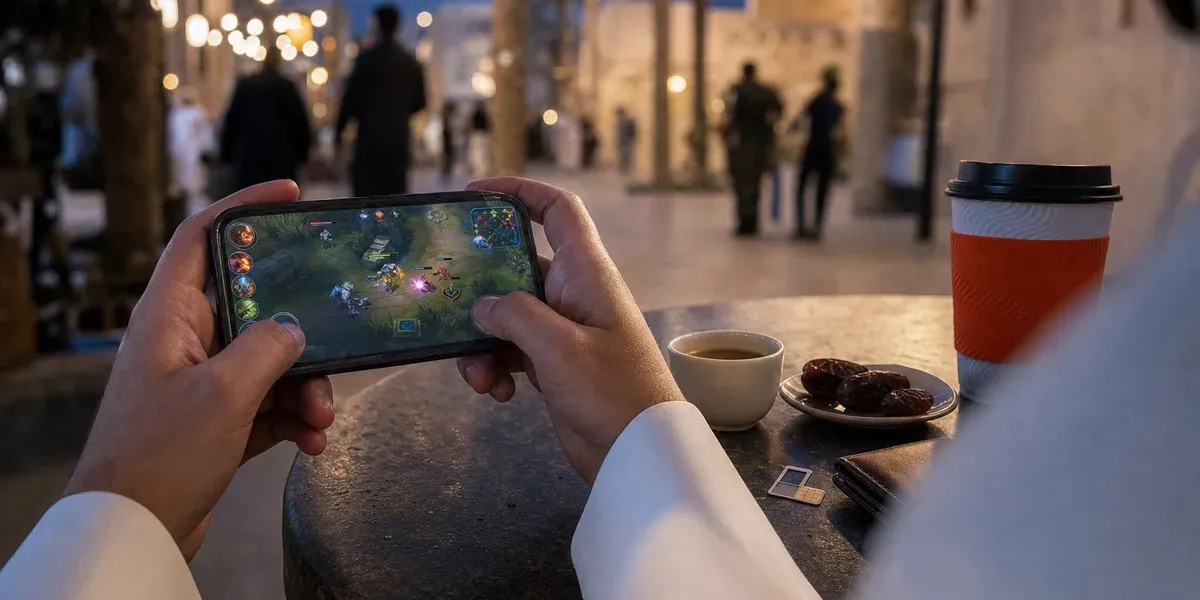
Direct answer — how do you distribute a mobile game in Saudi Arabia, the UAE and Egypt beyond Google Play? You keep Google Play and the App Store as the base, then make sure the payment layer under them is local: both stores already offer carrier billing through the main operators in all three countries, and that rail does a lot of the conversion work a card-only checkout can’t. On top of that you add Huawei AppGallery where your audience owns Huawei devices, a direct web shop with local wallets and cash networks (Egypt especially), and two things studios routinely underestimate: a local age rating and a properly mirrored Arabic UI. MENA mobile game distribution is less about finding a new store than about getting payments, ratings and right-to-left localisation right in three markets that behave very differently.
This is the next leg of our regional distribution series, after the Southeast Asia playbook and the LATAM playbook. As in both, we will not quote a regional market size: the figures circulating for “MENA gaming” mix platforms, years and country sets, and you do not need one to make the decisions below.
Why are Saudi Arabia, the UAE and Egypt three different launches?
Because the money, the payment habits and the regulator differ in each, and a “MENA” line item in a launch plan hides all three.
Saudi Arabia is a state-backed games market with a mobile publisher in its portfolio. The National Gaming and Esports Strategy, unveiled by the Crown Prince in September 2022, projects 39,000 new job opportunities by 2030 according to the Saudi Press Agency, as reported by Arab News. Through the Public Investment Fund’s wholly owned Savvy Games Group, the Kingdom also completed the acquisition of Scopely for $4.9 billion in July 2023, a company Savvy describes as “one of the world’s most diversified mobile-first games companies”. For a studio, that means serious local capital and an active regulator (see below).
The UAE is positioned as a hub. The Dubai Program for Gaming 2033, launched in November 2023, aims to place Dubai among the top 10 cities in the global gaming industry, generate 30,000 new jobs in the sector and add approximately $1 billion to GDP by 2033. That is an industrial policy aimed at studios and partners setting up locally, not a player-acquisition channel, so plan the UAE as a market with its own operators, regulator and payment mix rather than as a gateway to the rest of the region.
Egypt is the market of the three where checkout design is most likely to decide conversion: Xsolla’s March 2025 Egypt additions were wallets and cash networks rather than cards (more on that below). Treat it as a reach-and-conversion market, closer to the logic of our emerging-markets carrier billing map than to the Gulf.
Whether that three-market stack is worth building in-house, or running through a partner that already holds the operator, payment and rating relationships, is the kind of decision our distribution practice exists to de-risk.
Is carrier billing already available on Google Play and the App Store in MENA?
Yes, on both stores, in all three countries, which changes the calculation. Direct carrier billing (DCB) in MENA is not only an OEM-store or web-shop feature you have to integrate yourself; it is already wired into the two default checkouts. What each store lists today:
| Country | Google Play carrier billing | App Store mobile phone billing |
|---|---|---|
| Saudi Arabia | Mobily, STC, Zain, Virgin | Mobily, STC, Zain |
| UAE | du, Etisalat | Du, Etisalat |
| Egypt | Vodafone, e& | Vodafone |
Sources: Google’s accepted-payment-methods pages for Saudi Arabia, the UAE and Egypt; Apple’s payment methods page, which adds that mobile billing “is available only with supported carriers” and that the list is subject to change.
Two caveats in Google’s fine print matter: “Prepaid mobile numbers may not be supported”, and “some mobile phone carriers can’t be used to pay for subscriptions”. If your economy leans on subscriptions or a prepaid-heavy audience, test the checkout per operator before you forecast against it. In the UAE, Google also notes that players may need to add a spending cap on their carrier account, a friction step you will see in your funnel.
On fees, MENA is still on the old Google Play rate card. Google’s lower 2026 service fees roll out to the “Rest of World” on 30 September 2027. Until then, Play charges developers enrolled in the 15% tier 15% on the first $1M (USD) they earn each year and 30% above that, with 15% on auto-renewing subscriptions. A studio above $1M a year selling consumables in Saudi Arabia, the UAE or Egypt keeps paying 30% on Play for roughly another year, which is what makes a direct web shop worth its integration cost.
That web shop needs local rails, and they differ sharply between the Gulf and Egypt. When Xsolla added 11 new local payment methods across MENA in March 2025, the Saudi addition was Sadad, while the Egyptian list was wallets and cash networks: Fawry Cash, Aman, Masary, Momken, Vodafone Wallet, Orange Cash Wallet and mobile and banking wallets. A card-led web shop is a reasonable start for the Gulf; in Egypt it skips the wallet and cash rails listed above.
Where does Huawei AppGallery fit in a MENA plan?
AppGallery is the alternative store that most often comes up for the region, and it is a real channel, but you should size it from your own device data rather than from a headline. No primary source publishes a reliable AppGallery share for Saudi Arabia, the UAE or Egypt, and we will not repeat the “dominant alt store in the Arab world” claim that circulates without one.
What is solid is the mechanism. Huawei’s newer devices ship without Google Mobile Services, so a player on one of them cannot reach your Play listing at all: AppGallery is the only store route to that device base, and the reach is incremental rather than cannibalised. Huawei’s in-app purchase service supports bank cards, Direct Carrier Billing and HUAWEI Points, and Huawei states that “DCB is supported by many large carriers outside the Chinese mainland”. Check the supported country list for your target operators before you assume a specific Gulf or Egyptian carrier is live.
The cost is engineering: every Google dependency in your build (Play Billing, Firebase messaging, Google sign-in, ads SDKs tied to Google services) needs an HMS equivalent. We compare that friction against Samsung Galaxy Store and Xiaomi GetApps in our OEM app stores comparison. Our rule of thumb for MENA: pull your device-model breakdown for the three countries and do the HMS port only if Huawei devices are a meaningful slice of the players you already have.
What do age ratings and Arabic localisation require?
More than a translation pass. Both Saudi Arabia and the UAE rate games themselves, and Arabic is a right-to-left language that breaks layouts built only for left-to-right.
Ratings. Saudi Arabia’s media regulator, the General Authority of Media Regulation (formerly the General Commission for Audiovisual Media), runs the Kingdom’s own age-rating system. Niko Partners notes that “Saudi Arabia introduced localized age ratings that replaced their reliance on the PEGI system”, and in July 2025 the Saudi authority and the UAE Media Council both cleared GTA V with a 21+ rating, the first time the franchise was cleared for an official release in both countries. For physical retail the rule is explicit: the Saudi Ministry of Media’s reference site states that “the game must be pre-classified with the Saudi age rating by the authority” before it can be cleared. For a store-distributed mobile title, confirm your rating obligations with the authority or a local partner before launch rather than assuming the IARC rating you already carry on Play covers you.
Content sensitivity is commercial too. In Niko Partners’ 2025 survey of 1,580 gamers in Saudi Arabia, the UAE and Egypt, 57% said they would consider whether to stop playing a game if it included content they deemed religiously or culturally offensive. Run a cultural review of art, text and event calendars alongside the translation.
Arabic and RTL. Android’s own localisation guidance is a good checklist even if you build in a game engine. It notes that people who use RTL scripts, Arabic included, “prefer an RTL user interface, which includes right-aligned menus, right-aligned text, and forward arrows pointing to the left”, that RTL mirroring is supported from Android 4.2 (API level 17), and that layouts should use start and end rather than left and right. It also flags that most Arabic locales use their own set of digits, which can break string formatting that assumes Western numerals. In practice: mirrored menus and HUD, a font pipeline that renders connected Arabic script, and number formatting tested on an Arabic-locale device. Localise the store listing and payment sheet first.
What should a studio do next?
A practical sequence, tuned to where payment and regulatory friction sit:
| Market | Distribution priority | Payment must-haves | Watch out for |
|---|---|---|---|
| Saudi Arabia | Play + App Store first; AppGallery if your device data justifies it | Carrier billing via STC, Mobily, Zain on both stores; Sadad and cards on the web shop | Local age rating; cultural content review |
| UAE | Play + App Store; hub for local partners | Carrier billing via du and Etisalat; cards | UAE Media Council rating; DCB spending caps |
| Egypt | Play first, App Store second; AppGallery optional | Carrier billing via Vodafone (both stores) and e& (Play); wallets and cash networks on the web shop | Card-only checkout; prepaid lines that DCB may not cover |
Three rules cut across the table. First, turn on and test carrier billing before buying traffic: it is already in both stores, so the work is verification per operator, not integration. Second, build the web shop around the Play fee timeline, because MENA stays on the 15%/30% structure until 30 September 2027. Third, put the rating and the RTL pass on the critical path, not in the polish backlog.
FAQ
Does Google Play support carrier billing in Saudi Arabia, the UAE and Egypt?
Yes. Google lists Mobily, STC, Zain and Virgin as participating carriers in Saudi Arabia, du and Etisalat in the UAE, and Vodafone and e& in Egypt. Google also warns that prepaid numbers may not be supported and that some carriers cannot be used for subscriptions, so test your checkout per operator.
Does the App Store offer carrier billing in MENA?
Yes. Apple lists mobile phone billing with Mobily, STC and Zain in Saudi Arabia, Du and Etisalat in the UAE, and Vodafone in Egypt, available only with supported carriers and subject to change.
What does Google Play charge in Saudi Arabia, the UAE and Egypt?
The pre-2026 structure still applies there: 15% on the first $1M (USD) a developer enrolled in the 15% tier earns each year, 30% above that, and 15% on auto-renewing subscriptions. Google’s lower service fees reach the rest of the world on 30 September 2027.
Is Huawei AppGallery worth it for MENA?
Only if Huawei devices are a meaningful share of your players. AppGallery is the only store route to Huawei devices without Google Mobile Services, and Huawei’s in-app purchases support carrier billing, but the HMS porting work is real. Size it from your own device analytics, not from a headline market share.
Do I need a local age rating to launch a game in Saudi Arabia?
Saudi Arabia runs its own age-rating system through the General Authority of Media Regulation, and physical retail requires a pre-assigned Saudi rating. For store-distributed mobile titles, confirm your obligations with the authority or a local partner before launch rather than relying on your IARC rating alone.
Sources
- Accepted payment methods on Google Play - Saudi Arabia
- Accepted payment methods on Google Play - United Arab Emirates
- Accepted payment methods on Google Play - Egypt
- Payment methods that you can use with your Apple Account
- Service fees - Play Console Help
- Understanding Google Play's lower service fees
- HUAWEI In-App Purchases — About the Service
- Xsolla expands local payment options to the MENA region to reach more players and boost revenue in top-growing markets
- Saudi Crown Prince unveils National Gaming and Esports Strategy
- Savvy Games Group Completes Acquisition of Scopely
- Hamdan bin Mohammed launches 'Dubai Program for Gaming 2033'
- Grand Theft Approval: A turning point for MENA game regulations
- What Are the General Controls for the Clearance of Electronic Games in the Kingdom?
- Support different languages and cultures