OEM partnerships are a quietly great channel for indies
Most indies write off OEM deals as enterprise-only. They're missing a channel that often outperforms the dominant storefronts on revenue share, exposure and audience fit.
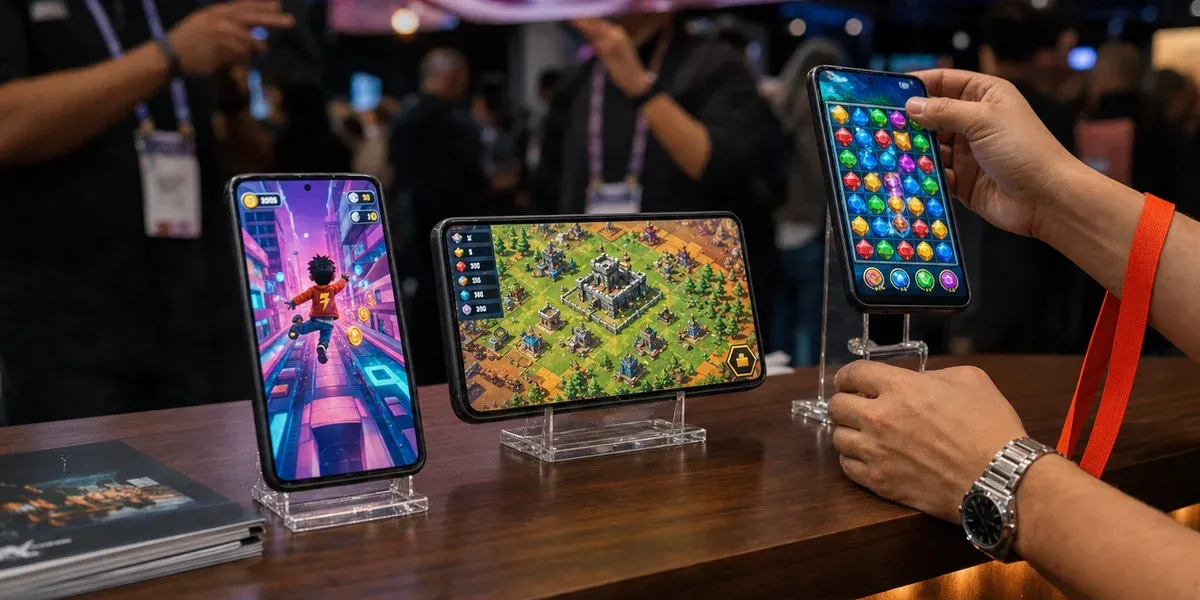
“OEM”, original equipment manufacturer, is one of those terms that sounds enterprise. It conjures images of long procurement cycles, bilateral contracts with telcos, decks full of acronyms, and a procurement team in Seoul or Shenzhen that doesn’t return your emails. So most indie publishers ignore it.
That’s a mistake — particularly in 2026, when several OEM channels have rebuilt their partner programmes specifically to court indies.
What OEM distribution actually looks like
When a Samsung Galaxy ships in Brazil, or a Xiaomi handset rolls into a carrier-bundled deal in Indonesia, that device doesn’t arrive empty. It arrives with a curated set of pre-installed apps and a storefront layer that’s deeper and more frequented than most outside developers realise.
There are three distinct distribution surfaces that an OEM channel can give you, each with very different mechanics.
The OEM’s own storefront. Samsung Galaxy Store, Xiaomi GetApps, OPPO App Market, Vivo V-Appstore, Huawei AppGallery. These are the equivalent of Play Store on each manufacturer’s devices: discovery surface, in-store ads, ratings, payments. On many devices outside North America and Western Europe, the OEM store is the user’s actual default.
Pre-installs. Negotiated content slots on the device’s launcher or in its setup flow. These are the high-value, contested slots: the publisher pays nothing for the install, the OEM takes a revenue share, and the title gets onto the home screen of every device sold in the deal’s scope. Pre-install slots used to be the preserve of the largest publishers. They’re not, any more — we walk through how a mid-size studio actually lands one in our OEM preload deal playbook.
Carrier-billing storefronts inside OEM channels. In markets where credit card penetration is low, OEM stores integrate direct carrier billing (DCB) with local telcos. This is the conversion mechanic that makes Asia, MENA, and parts of LATAM economically viable for mobile monetisation. We touch on this in our alternative app stores deep dive, but it deserves its own attention here because for indies it’s often the single most underestimated revenue lever.
Why indies usually pass
Three reasons, all reasonable.
Perceived complexity. Working with OEMs sounds like an enterprise deal because, historically, it was. The first wave of OEM publishing programmes in the mid-2010s were designed for hits-of-the-quarter from major publishers. Indies hit either a closed door or an SDK integration estimate that didn’t make economic sense.
Revenue uncertainty. Most indies don’t know what an OEM deal actually pays per install, or whether the install quality compares to a normal storefront install. The data is hard to find, partly because most public case studies come from publishers that don’t fit an indie profile, and partly because OEM partner managers (rightly) treat revenue specifics as commercially sensitive.
Operational overhead. Each OEM channel implies its own build flavour, its own SDK constellation, its own review process. For a five-person studio, that overhead can swallow the bandwidth needed to ship the next title.
All three are real concerns. They are also, in 2026, considerably more solvable than they used to be.
What’s actually changed since 2024
Three structural shifts have pulled the indie threshold down sharply.
Partner terms opened up. Samsung improved Galaxy Store’s headline terms for every developer in May 2025, moving to an 80/20 split on paid games, apps and in-app items and 85/15 on auto-renewing subscriptions — better than the 30% the duopoly charges, and published rather than left to be asked for. Xiaomi GetApps has a partner-services arm that handles localisation, regional submission and basic LiveOps support. Huawei AppGallery has been actively courting non-Google-Mobile-Services-friendly Android publishers since the US trade restrictions kicked in. AppGallery’s HMS Core SDK suite is mature enough that an indie team can integrate it in roughly the same time as Google Play Services.
SDK constellations consolidated. A single billing abstraction (often via a payment aggregator like Codapay, Boku, or DigitalVirgo) can now reach a meaningful basket of OEM stores and carrier billing endpoints with much less per-store work. Five years ago you integrated five SDKs to reach five storefronts. Today, with the right aggregator, you integrate one or two and reach most of the relevant universe.
Aggregator partners emerged. Mid-tier distribution partners now broker indie-OEM relationships at scale, taking a share of revenue in exchange for handling submission, ad SDK wiring, partner reporting, and the political work of getting a small title featured. Platforms like KYLN — formed by ex-GameBake and mobile OEM ad company AVOW — package this as a single integration-free surface across several OEM storefronts at once. This is what makes “I’m a four-person studio in Lyon and I want to be on Samsung Galaxy Store in Brazil” go from impossible to a six-week project.
The economics: when OEM starts to pay
Here’s a useful test: if your game already monetises well via ads (CPM-driven) and you have a build that runs on mid-range Android devices, you are essentially the customer OEMs are looking for. The fit is direct: they want premium, low-friction interactive content on their devices; you want low-CPI distribution that compounds with audience.
The math falls apart for titles that depend heavily on first-party billing flows tied to App Store identity, premium pricing models that the regional cohort won’t pay, or App Store-specific user behaviour. For everything else, OEMs deserve a real conversation, not a default no.
A more granular set of rules of thumb from publishers we’ve worked with:
- Mid-core or hyper-casual ad-monetised titles are almost always a good fit for at least one OEM channel.
- IAP-driven titles with strong global pricing can work, but need carrier billing integration to make the regional economics work.
- Premium one-off purchase titles generally underperform on OEM channels outside Korea and Japan.
- Subscription titles depend almost entirely on payment plumbing: if the OEM store can host the subscription with its native billing, the title can compete; if not, it usually can’t.
If you want a deeper read on which categories monetise where, our distribution overview walks through the per-market patterns we see most often.
A region-by-region snapshot
The OEM landscape is regional. There is no global OEM strategy, only a sequence of regional ones.
Brazil, Mexico, Latin America
Samsung Galaxy Store is dominant on the device side because Galaxy share is exceptionally high in the region. Xiaomi has been gaining ground rapidly in Mexico and Argentina. Both stores feature heavily in carrier-bundled deals (Claro, TIM, Movistar, Telcel) and direct carrier billing is a real conversion lever. Spanish and Brazilian Portuguese localisation is non-negotiable.
Indonesia, Vietnam, Philippines, Thailand
This is where the OEM-plus-carrier-billing combination really shines. Smartphone ownership is high, card penetration is low, OEM stores are the default discovery surface. Xiaomi, OPPO, Vivo and Samsung all have significant share. Local language support and culturally-tuned creatives matter more here than in any other market. For a full market-by-market breakdown of which OEMs are winning which country and how to sequence the OEM-plus-DCB stack across Indonesia, Vietnam and the Philippines, see our Southeast Asia distribution playbook.
India
Xiaomi GetApps is the largest OEM storefront by far. Samsung Galaxy Store has a meaningful share among premium device owners. Carrier billing is widespread but with low per-transaction caps, which makes pricing strategy delicate. The compliance overhead is non-trivial (data residency, in-app billing rules from the Competition Commission of India).
MENA, parts of Africa
Huawei AppGallery has carried significant share since the Google Mobile Services restrictions. Samsung Galaxy Store is competitive in the Gulf. Carrier billing is mature in Egypt, Saudi Arabia, the UAE and South Africa. None of that reaches Sub-Saharan Africa, where Transsion’s Palmstore — preinstalled on Tecno, Infinix and itel devices — is the dominant on-device channel.
Eastern Europe, Russia, Central Asia
Huawei AppGallery and Samsung Galaxy Store both have meaningful presence. Pre-install slots in regional carrier bundles are often more impactful than featured placement in the storefront itself.
China (out of scope, but worth noting)
Mainland China has its own constellation of OEM-led stores (Tencent MyApp, Vivo, OPPO, Xiaomi, Huawei) and no Google Play. The work to enter China is closer to “launching in a new platform ecosystem” than “adding a channel”. Most indies should plan to either commit fully or skip it.
What changes between “interested” and “shipped”
Three layers, each with its own characteristic gotcha.
Build adaptation. Packaging, SDK choices, regional compliance. For most studios, the time-consuming part is not the SDK integration itself (mature aggregator SDKs handle most of it) but the QA matrix: testing payment flows across five carrier-billing endpoints and three OEM stores on devices you may not own physically. A device farm partner (BrowserStack, Kobiton, or a regional QA shop) is often a worthwhile line item here.
Submission and onboarding. Each partner’s review cadence is different, and none of the three publishes a guaranteed turnaround — plan in days rather than hours, and don’t put a launch date on an unreviewed build. Xiaomi GetApps in particular can be faster or slower depending on the regional submission queue. Budget separately for the one-off account setup: Samsung says commercial-seller approval can take up to 10 business days to verify your D-U-N-S number, and up to 10 more for an international bank account. Content guidelines vary, particularly around gambling mechanics, suggestive content, and certain rating dimensions. Building a one-page checklist of regional sensitivities per market avoids most surprises.
Ongoing operations. Release coordination, ad-network reconciliation across multiple monetisation stacks, partner reporting. The studios that do this well usually designate one operator (a person, not a team) as the channel owner per OEM. Without that, the channel becomes everyone-and-no-one’s responsibility and the relationship decays.
If you’re a small team and the operational layer is the constraint, this is exactly where the IMH founding developer programme is most useful: we shoulder the channel-ownership work so the studio can stay focused on the game.
The carrier billing question
For any OEM channel in Asia, MENA, or LATAM, the question of whether to add carrier billing comes up early. The honest answer is: in most of these markets, carrier billing isn’t an optimisation, it’s the conversion mechanic. For the full picture on where DCB beats cards and what integration involves, see our publisher’s guide to direct carrier billing.
Three patterns we see repeatedly in our own channel work, rather than published data:
- In Indonesia and the Philippines, carrier billing carries the majority of monetised transactions on titles whose IAPs sit at the low end of the price ladder.
- In Egypt, Nigeria and parts of South Africa, carrier billing is often the only viable mechanism for transactions below the local card processor’s minimum.
- In India, the regulatory and transaction-cap landscape means carrier billing is impactful for low-ticket items but not for high-ticket purchases.
The integration is usually mediated through an aggregator (Boku, Codapay, DigitalVirgo, Fortumo) rather than direct telco contracts. The aggregator handles the local compliance, reconciliation, and FX. Aggregator fees are negotiated rather than published, and vary with market, volume and contract terms — get them in writing before you model the unit economics.
What a 12-month indie OEM plan looks like
For an indie studio asking “what’s a realistic 12-month plan”, the shape of one we’ve seen work several times:
- Months 1-2. Pick two OEM channels that match the title’s audience-market fit. Most often: Samsung Galaxy Store in one region (Brazil, Indonesia, or India), plus one of Xiaomi GetApps or Huawei AppGallery for diversification.
- Months 2-4. Build adaptation: SDK aggregator integration, regional QA pass, localisation, store metadata. Submission to both partners.
- Months 4-5. Soft launch in one country per channel. Measure CPI, retention, payer rates against your existing benchmarks.
- Months 5-7. Iterate creatives and store metadata based on data. Negotiate first featured slot or pre-install bundle with the channel partner.
- Months 7-12. Scale to additional countries within each channel. By month 12, the channel should be on a quarterly LiveOps cadence equivalent to Play Store.
The total integration cost for a four-to-six-person indie team is typically 8-14 weeks of one engineer plus part-time QA, depending on SDK starting point and the title’s payment surface. The break-even point depends on the title’s existing scale, but most indies who commit at the level above see the channel cover its own integration cost within 6-9 months of soft launch.
FAQ
Is an OEM partnership only viable for big publishers in 2026?
No. Headline terms have moved in developers’ favour — Samsung cut Galaxy Store’s take to 20% in May 2025, and 15% on subscriptions — and aggregator-driven SDK integration has sharply reduced the engineering cost versus integrating each manufacturer directly. Indies who commit to two channels and operate them seriously can hit channel scale within a year.
Which OEM store should an indie pick first?
For most indie titles, Samsung Galaxy Store in one strong-Samsung-share market (Brazil, Indonesia, or several EU countries) is the highest-probability first pick. The partner programme is the most developer-friendly, the SDK is mature, and the carrier billing integration is broad. Huawei AppGallery is a strong second pick if the title is well-positioned for MENA, Eastern Europe, or Russia.
How does OEM revenue share compare to Google Play?
Samsung publishes its rate: 20% of net sales proceeds on Galaxy Store since 15 May 2025, and 15% on auto-renewing subscriptions. Huawei has run incentive windows leaving game developers 85% of revenue outside mainland China. Google Play charges 15% on a developer’s first 1M USD of annual earnings and 30% above it in markets where its updated fee structure has not yet rolled out; in the EEA, UK and US it moved on 30 June 2026 to 20% plus a 5% billing fee for new installs. Preload-based deals are sometimes net-revenue arrangements rather than commissions.
Do I need a separate APK for each OEM store?
Not necessarily. A well-structured Android build can target multiple OEM stores from a single source tree, with SDK substitutions handled via build flavors. The exception is Huawei AppGallery, which requires HMS Core in markets without Google Mobile Services and is best handled as a separate build flavor.
What’s the realistic timeline from “decision to ship on Samsung Galaxy Store” to first installs?
For a studio with an existing Android title, 8-12 weeks is a realistic window from kickoff to soft launch in one country. The biggest variability is QA coverage and content compliance — the engineering integration itself is usually 3-4 weeks.
How does carrier billing integration affect ad-network compatibility?
It generally doesn’t. Carrier billing is a payment mechanism for IAPs, parallel to your ad monetisation stack. The aggregator’s SDK and the ad SDK live in the same binary without contention. The thing to watch is fraud/integrity policies on some ad networks that flag low-card-penetration markets — be prepared to whitelist with your ad partners.
Can I run paid UA on an OEM store the same way I do on Play?
The mechanics are similar in principle (in-store ads, featured slots, paid promotion) but the surfaces and the partner relationships are different. Most OEM stores will engage on featured-slot negotiation directly if the title is already performing organically. Paid UA on alt-stores typically supplements, rather than substitutes for, your existing UA stack.
If you’d like to walk through the math for your specific title — which two OEMs match your audience, what the integration timeline looks like, what aggregator partner makes sense — let’s talk. And for context on how OEM channels fit into the broader alternative-distribution picture — including games-only iOS stores like Skich and Onside, the EU complement to Android OEM channels — and our studio-side practice, those pages walk through the rest of the model.
Sources
- New Revenue Share Model for Galaxy Store
- Galaxy Store FAQ
- Get Started in Galaxy Store
- Huawei's AppGallery will pay developers up to 100% of revenue for the first two years
- Grow with Xiaomi: Building a Sustainable Open Ecosystem for Apps, Services and Contents
- Service fees
- Membership Details - Apple Developer Program
- AVOW joins forces with former GameBake team, forming KYLN