PHYND cloud gaming for publishers: real channel or reach play?
PHYND signed Microids, Fishing Cactus and Plug In Digital for free ad-supported cloud gaming on TVs. What the deal covers, and what it still does not disclose.
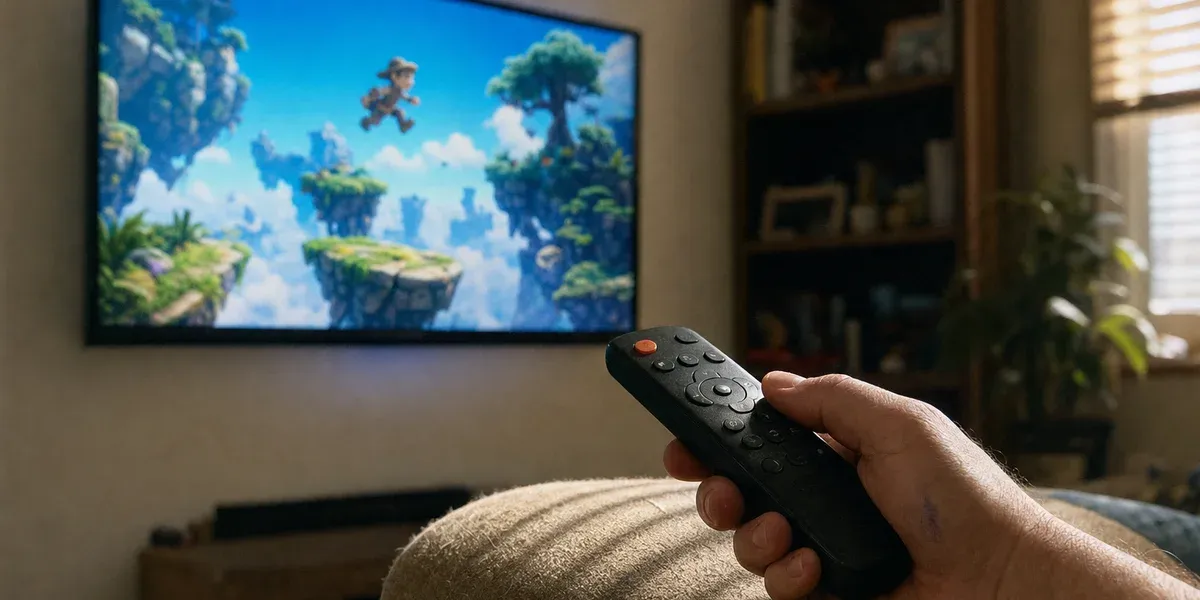
Direct answer — should a publisher sign a game to PHYND’s free ad-supported cloud gaming platform? PHYND is a funded, live distribution surface — a subscription-free, ad-supported cloud gaming service for TVs — and it already carries titles from Microids, Fishing Cactus and Plug In Digital. But as of September 2026 it is a United States beta on LG and Fire TV hardware, and PHYND has published no revenue-share terms anywhere. Treat it as a reach experiment for controller-friendly back-catalogue, and make your first call about the payout unit, not the TV count.
Every few years a new screen claims to be the next games channel, and most of the time the pitch deck moves faster than the payouts. PHYND is worth taking seriously anyway, for one unglamorous reason: it is signing exactly the kind of European mid-size and indie publishers who read this site, and it is doing so before it has said in public what it pays them.
What has PHYND actually shipped?
PHYND is a US company that streams games to televisions with no console, no download and no subscription, funded by advertising instead of a paywall. Magnite’s press release states the proposition bluntly: “No console. No downloads. No subscription fees.”
The company announced a $10 million oversubscribed seed round on 11 February 2025, led by Wellington Management, with Bessemer Venture Partners, Connecticut Innovations Fund and Jozy Altidore participating. Founder and CEO André Swanston comes from ad tech, not games: PHYND’s funding release describes him as CEO and co-founder of Tru Optik, a streaming-TV data business that underwent a “nine-figure acquisition”. That lineage explains why the demand side of this platform was built before the supply side.
The distribution announcements landed in sequence:
- 19 August 2025, gamescom. A global distribution collaboration with Samsung on the Samsung Gaming Hub, “Launching first in the United States”, with global markets following in 2026.
- 6 January 2026, CES. Magnite named as monetisation launch partner. Beet.TV’s CES report describes the split as “Magnite will serve as PHYND’s programmatic partner for its SSP, while SpringServe will handle ad serving” — a conventional connected-TV ad stack, not a games ad network.
- 29 January 2026. An LG deal covering LG’s Gaming Portal, PHYND stating the integration reaches “240 million LG Smart TVs”.
- 24 July 2026. LG beta live in the United States, on LG Smart TVs from 2021 and newer running webOS 6.0 or higher.
- 11 August 2026. Fire TV beta live in the United States, on named Fire TV Stick 4K and Fire TV Cube models plus Amazon’s Ember TV lines, via the Amazon Appstore.
The roster is the interesting part. PHYND’s Fire TV release describes “a curated catalog of games from leading independent studios and publishers” and names five: Microids, Tate Media, Fishing Cactus, Plug In Digital and 34BigThings. The July LG release named Midwest Games in that slot instead. This is a catalogue being assembled one signature at a time — which is exactly why a publisher reading this now has leverage it will not have in eighteen months. Mapping where a surface like this sits against the stores and OEM channels you already run is the sequencing work our distribution practice does first.
What does the PHYND deal actually look like for a publisher?
Here is the honest answer: nobody outside the signed publishers knows, because PHYND has not published terms.
We looked for them. There is no developer portal, no partner page and no submission flow on phynd.co — the site’s navigation runs Team, News, Player and Contact Us, and its pitch to studios ends at “Partner with us, the most accessible gaming platform ever!” Every deal is a conversation.
What is on the record is the shape of the money:
- Revenue comes from advertising and sponsorship, not from a transaction. PHYND’s LG announcement frames the model as one where “the more a game is played, the more its creators earn”, through “non-intrusive, audience-based advertising”. That is a usage-linked payout, not a commission on a sale.
- The ad load is deliberately light and sits outside gameplay. AdExchanger reported in March 2025 that “the ad inventory will be 15- or 30-second spots that run while a cloud-based game is loading”. Beet.TV’s August 2026 report says PHYND focuses on pre-roll advertising and sponsored rewards rather than in-game interruptions, quoting Swanston: “Whether it’s seeing an ad, whether it’s giving you a reward or sponsored experience, we’re helping you access this game for free.”
- In-game transactions are not excluded. PHYND’s own site lists “Ad revenue with non-intrusive, Smart TV-optimized formats” and “In-game transactions” side by side, but says nothing about the split on either.
- There is a licensing lane too. Swanston told AdExchanger that “we’ve also seen a tremendous opportunity for licensing of older or unmonetized content” — which reads as flat-fee catalogue deals for back-catalogue, a very different instrument from a rev-share.
Read those together and the negotiation writes itself. A light ad load is good for players and bad for yield per session; a usage-linked payout on light inventory only works at scale; and scale, today, is a US beta. The terms-sheet questions follow: what is the payout unit (session, hour, impression, or a flat licence), is there a floor, who owns the player data, is there an exclusivity window, and what happens to your rate when the catalogue goes from five publishers to five hundred.
How does PHYND compare with the cloud channels you already know?
The structural difference is real and it is the strongest thing in PHYND’s favour. The incumbent cloud services distribute access to games the player has already paid for, one way or another.
| Channel | What the player must already have | Where the publisher’s money comes from | Terms published? |
|---|---|---|---|
| PHYND | A supported LG TV or Fire TV device, in the US | Advertising and sponsorship on the platform; licensing for some catalogue | No |
| NVIDIA GeForce NOW | The game, bought on a supported PC store | The original store sale, wherever it happened | Yes, via Steamworks opt-in |
| Xbox Cloud Gaming | A Game Pass subscription | The Game Pass relationship, not a per-stream sale | Relationship-gated |
NVIDIA’s FAQ is unambiguous: “Yes, you need to own or purchase a game from one of the supported game stores before playing it on GeForce NOW.” Xbox Wire’s February 2026 update says “Xbox Game Pass Ultimate, Premium, and Essential subscribers can now stream from a library of 1000+ games they own, across supported devices.” Both are gated by design — we unpacked those economics in cloud gaming distribution: a channel for publishers, not a tech demo.
PHYND removes both gates. A player with a 2021 LG TV can be in a Microids title in under a minute, having paid nothing and installed nothing. For a publisher whose problem is discovery, that is a genuinely different funnel — the argument that makes non-auction channels worth building in the case for distribution beyond paid UA. What PHYND has not shown is that removing the gate produces money on the other side.
Do the reach numbers survive a scope check?
This is where discipline pays. PHYND’s public figures are large, self-published, and describe different things.
- PHYND states its LG Gaming Portal integration reaches “240 million LG Smart TVs” — PHYND’s own count of the global LG Smart TV base the Gaming Portal addresses, not a PHYND user number and not a US number.
- PHYND’s August 2025 Samsung release said “With over one billion smart TVs shipped globally in the last five years, the market potential is massive” — global shipments of all smart TVs over the five years to August 2025.
- PHYND’s February 2025 funding release used a tighter number for the same idea: “More than 500 million smart TVs capable of supporting a cloud gaming app have shipped globally” over the past five years. Same company, six months apart, half the number — because the qualifier changed. Shipments are not installed base, and installed base is not addressable audience.
- Beet.TV’s January 2026 CES report states, without naming a dataset, that “In the United States, smart TV penetration sits at roughly 80% of households. Console and gaming PC penetration? Just 40%.”
- Beet.TV reported in August 2026 that “Swanston said in June that only about one-third of television households worldwide have a gaming console” — the CEO’s own claim about console ownership among TV households worldwide.
Against all of that, what is live is a United States beta on two hardware families with a catalogue from five named publishers. In February 2025 Swanston expected a launch catalogue that “could be in the hundreds”, per GamesBeat. That is the gap between the deck and the deployment, and it is the gap your forecast has to sit in.
The demand-side thesis has the same shape. PHYND’s pitch, as reported by GamesBeat, is that games on the large screen generate “only about 7% of their revenue from ads or sponsors, compared to 50% for the broader media sector” — no dataset named for either figure. The direction is plausible and the ad-tech team is credible; the yield is still hypothetical. Swanston set the honest scorecard himself, telling The Drum in August 2025 that “Retention, frequency of play, brand investment in ads and developer satisfaction with revenue will be the early signals of success.” Two of those four are visible only to a signed publisher.
What should a studio do next?
Who should take the meeting. Publishers with a controller-native PC or console back-catalogue that is no longer earning — family, party, puzzle and arcade above all, given who has signed. If your catalogue looks like Microids’ or Plug In Digital’s, you are the target profile. PHYND is prospecting actively: Cloud Dosage reported on 5 August 2026 that VP of Gaming Strategy and Community Growth Ney Castro would be at PAX West (4–7 September 2026, Seattle) to meet developers and publishing teams, though PHYND announced no booth, panel or public demo.
What to ask for in the first call. The payout unit and its definition. A floor, minimum guarantee or fixed licence fee for the beta period — a usage-linked share of an unproven ad pool is not a commercial term, it is an option. Per-title reporting granularity. Non-exclusivity in writing. A termination clause that does not strand your build.
What to measure. Run it as an incremental-reach test, not a revenue test: sessions and session length per title, pre-roll completion, and any measurable lift in your other channels. Set a 90-day review and a revenue threshold below which you stop spending engineering time.
When not to proceed. If the ask is exclusivity, engineering work on a live title, or a port you fund, the answer today is no — the reach is not proven enough to underwrite it. If your catalogue is mobile free-to-play built for touch and IAP, this is the wrong shape of channel; the web and instant surfaces sequenced in our multi-channel distribution framework will serve you better.
FAQ
Does PHYND pay publishers a revenue share?
PHYND describes an ad-funded model in which, as its LG announcement puts it, “the more a game is played, the more its creators earn”, through “non-intrusive, audience-based advertising”. It has not published a percentage, a payout unit or a minimum guarantee anywhere public, and there is no developer portal or partner page on its site. Terms are negotiated case by case, so treat any number you hear as deal-specific rather than as a platform rate.
Where can players use PHYND today?
As of September 2026, in the United States only. The LG Smart TV beta launched on 24 July 2026 for LG TVs from 2021 and newer running webOS 6.0 or higher; the Amazon Fire TV beta launched on 11 August 2026 across supported Fire TV Stick 4K and Fire TV Cube models and Amazon’s Ember television lines. A Samsung Gaming Hub collaboration and an LG Gaming Portal integration are announced, with wider markets stated for 2026.
How is PHYND different from GeForce NOW or Xbox Cloud Gaming?
Ownership and subscription. NVIDIA’s FAQ states “you need to own or purchase a game from one of the supported game stores before playing it on GeForce NOW”, and Xbox Wire describes Game Pass Ultimate, Premium and Essential subscribers streaming “from a library of 1000+ games they own”. PHYND requires neither: the player pays with attention instead. That makes it a top-of-funnel reach channel rather than a way to serve players who have already bought your game.
Weighing an ad-funded TV channel against the alternative stores, OEM deals and web-native routes already in your plan? Let’s talk it through — and if you are early-stage, our founding developer programme covers the channel negotiation and integration work directly.
Sources
- PHYND Beta Launches on Amazon Fire TV Devices, Expanding Free Cloud Gaming Access
- PHYND Expands Cloud Gaming Beta to Amazon Fire TV
- PHYND Expands Free Cloud Gaming Footprint with LG Smart TV Beta Launch
- PHȲND Joins Forces with LG to Bring Free Cloud Gaming to Millions via Gaming Portal in 2026
- Free Games, Smarter Ads: Magnite and PHȲND Redefine Gaming on Smart TVs
- Cross-Platform Cloud Gaming Comes With PHYND's Magnite-Powered Ads
- PHȲND to Deliver the Future of Big-Screen Gaming on Samsung Gaming Hub—No Console, No Subscription Required
- PHȲND Raises $10M Oversubscribed Seed Round for Revolutionary Free Smart TV Gaming Platform
- Phynd raises $10M for subscription-free smart TV cloud gaming platform
- Meet The Free Gaming Platform – Founded By An Ad Tech Vet – That's Putting CTV Ads In Video Games
- How Phȳnd plans to reshape cloud gaming by putting smart TVs front and center
- PHYND Heads To PAX West 2026 To Meet Developers And Publishers
- PHYND
- Frequently Asked Questions (FAQs) for GeForce NOW
- February Xbox Update: 1440p Streaming on Xbox Consoles, ROG Xbox Ally Updates, and More